MAIN
work in progress
| Scientific Name | Neoanthropus viridis |
| Lifespan | Avg: 70 human years |
| Average Height | 170 cm - 180 cm |
| Average Weight | 65 kg - 75 kg |
| to fill | to fill |
| to fill | to fill |
thanks
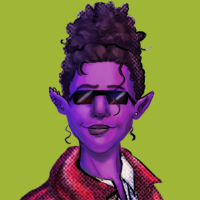
Viridians are characteristically tall and thin, have low body fat, and possess wide noses and dark skin. Viridians widely resemble the anatomy of homo sapiens, though notable differences include their skin color variation, bone density and ear structures.
Skin color variation: Viridians exhibit dark skin oftentimes leaning to cooler shades of blue and purple. This is an adaptation that protects them from the heavy amount of radiation coming from the Proxima Centauri star.
The reason for the purple and blue shades is because of the habitats Viridians typically reside in. Communities of Viridians are commonly found at areas covered by large plants with large leaves of purple or blue hue that shield them from the sun. Having this hue provides the plants with sun protection as the purple or blue leaves can increase the efficiency of photosynthesis and prevent damage to the plants' cells. This is due the compound Anthocyanin which absorbs the excess light photons that could hit chlorophyll and reduce the ability for the plants to photosynthesize.
Viridians who moved to less radiation exposed areas express colors of skin in the shade of green while those who moved further away exhibit a rarer shade of yellow. The percentage of skin color variation estimates to the following: Purple-skinned Viridians ~25% Blue-skinned Viridians ~25% Green-skinned Viridians ~45% yellow-skinned Viridians ~5%
thanks
thanks
| Scientific Name | Neoanthropus viridis |
| Lifespan | Avg: 70 human years |
| Average Height | 170 cm - 180 cm |
| Average Weight | 65 kg - 75 kg |
| to fill | to fill |
| to fill | to fill |